The short answer
Norbert’s Gambit converts Canadian dollars to US dollars inside a brokerage account by buying a dual-listed ETF in CAD, moving (“journaling”) the shares to their USD-listed version, and selling them for USD. It replaces a percentage-based currency conversion fee, commonly 1.5% or more at Canadian brokers, with a small fixed cost. It takes several business days and carries a little price risk, so it suits larger conversions better than small ones.
How it works
The method relies on one security that trades under two tickers. The Global X US Dollar Currency ETF is listed on the TSX as DLR (priced in CAD) and DLR.U (priced in USD). Some data providers and platforms show these as DLR.TO and DLR.U.TO. The two listings are the same fund, so shares can be moved from one to the other without a currency conversion.
- Buy DLR in the Canadian-dollar side of the account.
- Journal the shares to DLR.U after the trade settles. The broker moves the same shares from the CAD listing to the USD listing.
- Sell DLR.U for US dollars.
The technique is named after Norbert Schlenker, a British Columbia investment advisor credited with popularizing it. Inter-listed stocks can also be used in place of the ETF, but DLR is built for the purpose and is the usual choice.
Step-by-step (Questrade example)
The exact process varies by broker, so check the broker’s own journaling instructions before starting. At Questrade, the process is handled online.
- Check that the USD side exists. Confirm that the account has a USD balance or USD sub-account to receive proceeds.
- Buy DLR in CAD. Search for the CAD-priced ticker and place a limit order, which gives control over the price paid.
- Wait for settlement. Canada moved to a one-business-day settlement cycle in 2024, so settlement is typically one business day after the trade. Confirm the shares appear in the account before journaling.
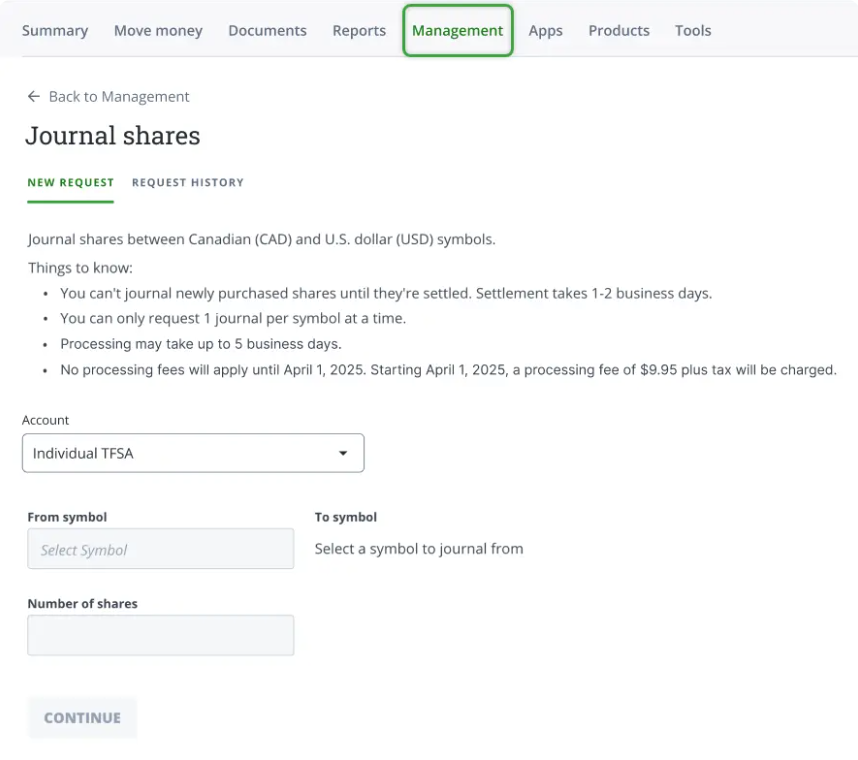
- Submit a journal request. In Questrade’s online platform, go to the Management page and choose Journal shares, then select DLR as the source and DLR.U as the destination. Request status appears under the Request History tab.
- Do not trade that security while the request is processing. Questrade asks clients not to trade the investment while a journal request is in progress.
- Sell DLR.U in USD once the shares appear on the USD side. A limit order is again worth considering.
Questrade says a journal request can take up to 5 business days to process. Journaling for RESP accounts goes through customer support rather than the online form.
What it costs
Three costs apply, and only the first is a fixed fee.
- Journal fee. Questrade charges $9.95 per online journal request, with unlimited free online journaling for Questrade Plus subscribers. National Bank Direct Brokerage charges $9.95 per security. A one-way conversion needs one journal request. Converting back to CAD later needs a second one.
- Trading commissions. Questrade lists $0 commissions on online trades of stocks and ETFs listed in Canada or the US. ECN and other fees may still apply to some trades.
- Spread and price movement. DLR and DLR.U have a bid-ask spread, and the price can move between the buy and the sell. Neither cost shows up as a line item, but both are real.
Break-even size
Compare the percentage fee a broker charges with the fixed cost of the gambit. If the fixed cost is roughly $10 to $20 and the broker’s conversion fee is 1.5%, the two come out about equal around $700 to $1,300. Above that, the gambit generally costs less.
| Amount converted | 1.5% conversion fee | Gambit fixed costs (approx.) |
|---|---|---|
| $1,000 | $15 | $10 to $20 |
| $5,000 | $75 | $10 to $20 |
| $10,000 | $150 | $10 to $20 |
The fixed-cost column excludes spread and price movement, so treat the break-even as approximate. Questrade’s published currency exchange fee is 1.5%.
Risks and common mistakes
- Price risk. DLR tracks the USD/CAD rate, and its price can move while shares settle and journal. The movement is usually small but can go against the trader.
- Wrong ticker. Buying DLR.U in a CAD account, or journaling in the wrong direction, creates delays and extra fees. Double-check the ticker and the currency before every order.
- Trading during the journal. Placing orders on the security while the request is processing can cause the request to fail or be delayed.
- Thin trading. DLR can be less liquid than large ETFs. Limit orders protect against a poor fill.
- Timing. Several business days pass between buying and receiving USD, so the method does not work for urgent conversions.
- Only equivalent securities can be journaled. The gambit works because both tickers are the same fund.
TFSA, RRSP, and tax notes
Many brokers allow the gambit in registered accounts that can hold US dollars, but a TFSA or RRSP needs a USD-capable account, so confirm with the broker first. In a non-registered account, any gain or loss on DLR when it is sold is a capital gain or loss. These tend to be small, but they are worth tracking for tax time. For the broader rules on how the TFSA is treated for frequent traders, see the guide to TFSA vs. non-registered accounts for active trading on this site.
When the gambit does not make sense
- Small amounts. Below the break-even, the fixed fees can cost more than a percentage-based conversion.
- Frequent small conversions. Fixed costs repeat each time, so a larger, less frequent conversion is usually the better fit.
- When speed matters. A same-day conversion is not possible.
- When a broker already offers a low-cost conversion. Some brokers and services advertise lower conversion rates, so comparing the all-in cost of each option is worth a few minutes.
Frequently asked questions
Is Norbert’s Gambit legal? Yes. It is a widely used approach that relies on normal securities transactions.
How long does it take? Plan on several business days, mostly for the journal step. Questrade states that journal requests can take up to 5 business days to process.
Does it work in a TFSA? Often, if the account can hold US dollars. The broker’s rules decide, so confirm before starting.
Can it be used in reverse, from USD to CAD? Yes. Buy DLR.U in USD, journal to DLR, and sell DLR in CAD. The same fees and timing apply.
Does every broker support it? No. Brokers differ on whether they allow journaling between the two listings and what they charge, so the broker’s own help pages are the place to check.
Sources and further reading
- Questrade: Journaling shares
- Questrade: Norbert’s Gambit and currency conversion
- Questrade: Self-directed investing pricing and fees
- Global X: US Dollar Currency ETF (DLR / DLR.U) product sheet
- Global X: DLR / DLR.U ETF Facts
- MoneySense: How to reduce foreign exchange costs using Norbert’s Gambit
- Canada Revenue Agency: Capital Gains guide (T4037)
This article is educational only. InvestSheep is not a licensed financial advisor or tax professional, and nothing here is financial, investment, or tax advice.